Chiang Mai Transport Guide: How to Get Around for Day Trips
Practical Chiang Mai transport guide for day trips — songthaew fares, tuk-tuk negotiation, bus to Chiang Rai, private drivers to Doi Inthanon. Real prices, real routes from someone who has taken every option.
Chiang Mai's day trip transport is simpler than it looks — but only once you know the system. I've done every option: the 20-baht songthaew, the overpriced tuk-tuk, the bus to Chiang Rai that takes longer than promised, and the private driver who knew back roads the tour vans skip. Here is what actually works, what costs too much, and what I would book if I were going tomorrow.
Songthaews: The Red Trucks That Run the City
The red songthaew is Chiang Mai's backbone. These are converted pickup trucks with two benches in the back and an open rear. You flag one down, tell the driver where you are going, and hop in. There are no fixed routes — they go roughly where passengers want, which means they sometimes take a scenic detour while the driver drops off three other people first.
A ride within the old city costs 30 baht. From the old city to Nimmanhaemin Road is 30-40 baht. From the old city to the bus station (Arcade) is 50-60 baht. The driver will quote a price when you tell them your destination — confirm it before you get in. The price is per person, and the truck may pick up other passengers along the way.
Songthaews stop running around 9-10pm. After that, your only option is Grab or a tuk-tuk. Grab from the old city to Nimman at midnight costs about 80-120 baht.
Who songthaews are NOT for: Anyone in a hurry. If you have a 9am tour departure, do not rely on a songthaew to get you there on time. Book a Grab or arrange a hotel pickup. I once missed a Doi Inthanon tour because my songthaew driver decided to stop for noodles. The tour left without me, and I lost the full booking fee.
Tuk-Tuks in Chiang Mai: When to Use Them and When to Walk
Chiang Mai tuk-tuks are smaller and quieter than Bangkok's — they are three-wheeled motorcycle cabs, not the noisy diesel machines of the capital. But the pricing is the same story: drivers quote tourists 150-200 baht for a ride that should cost 60-80.
My rule: never accept the first price. Halve it and negotiate from there. A ride within the old city should be 60-80 baht. From the old city to the Night Bazaar is 80-100 baht. If a driver won't budge below 150 baht, walk 50 meters and flag the next one. There is always another tuk-tuk.
Tuk-tuks are most useful for one thing: short hops when it is raining. A songthaew in the rain means sitting on a wet bench with water blowing in through the open back. A tuk-tuk has a roof and sides. For a 5-minute ride in a downpour, the extra 40 baht is worth it.
Who tuk-tuks are NOT for: Anyone heading to Doi Suthep. The road up the mountain is steep and winding — a tuk-tuk takes 25-30 minutes and you will arrive with your ears ringing from the engine noise. Take a songthaew from the base of the mountain (60 baht per person, waits until it fills with 8-10 passengers) or book a private car.
Getting to Doi Suthep: The Songthaew System
Doi Suthep is Chiang Mai's signature day trip — a golden temple 1,073 meters up, overlooking the city. The transport is straightforward but poorly documented for first-timers.
Songthaews to Doi Suthep leave from the base of the mountain, near the zoo entrance on Huay Kaew Road. Look for the cluster of red trucks with drivers calling "Doi Suthep." The fare is 60 baht per person each way, but the truck will not leave until it has 8-10 passengers. On a weekday morning, this can mean a 15-20 minute wait. On weekends, the trucks fill quickly.
You can also hire the entire songthaew for 400-500 baht round-trip — the driver will wait for you at the temple for 1-2 hours. This is the best option if you are traveling with 3-4 people, since 500 baht split four ways is about the same as the per-person fare with a guaranteed departure time.
The ride takes 20-25 minutes up a winding road with 14 switchbacks. If you get carsick, sit near the front and avoid looking at your phone. I learned this the hard way on my first trip up — the combination of diesel fumes, switchbacks, and staring at Google Maps had me queasy before we reached the halfway point.
Private Drivers for Doi Inthanon and Chiang Rai
For the longer day trips — Doi Inthanon (2 hours each way) and Chiang Rai (3 hours each way) — a private driver is often the best value once you account for time, comfort, and flexibility.
Private driver rates in Chiang Mai (2026 prices):
- Doi Inthanon full day: 2,000-2,500 baht for a sedan, 2,500-3,000 for an SUV. Includes hotel pickup, the summit, the chedis, Wachirathan waterfall, and a coffee plantation stop. The driver waits at each stop — typically 8-10 hours total.
- Chiang Rai full day: 3,000-3,500 baht. Covers the White Temple, Blue Temple, Black House Museum, and lunch. 12+ hours door to door. Worth it if you have 3-4 people splitting the cost.
- Doi Suthep + Bhubing Palace + Hmong village: 1,200-1,500 baht for a half-day. Better than the songthaew if you want to visit all three stops without waiting for other passengers.
A tour is often cheaper than a private driver for solo travelers and couples. A Doi Inthanon group tour costs 1,200-1,500 baht per person including lunch. A private driver at 2,500 baht is better value for groups of 3+. The tour also includes a guide who explains the history and ecology — the private driver is just transport.
I booked this Doi Inthanon small-group tour on my second visit and preferred it to the private driver I had used the year before. The guide pointed out bird species I would have missed and knew exactly when to hit each stop to avoid the tour bus waves.
Getting to Chiang Rai: Bus vs Private Car
The bus from Chiang Mai to Chiang Rai takes 3.5-4 hours and costs 180-250 baht on the Green Bus service. Buses leave from Arcade Bus Station (Bus Terminal 3) roughly every hour from 6am to 6pm. The Green Bus is air-conditioned and comfortable — comparable to a European coach.
But here is the problem: if you take the bus to Chiang Rai for a day trip, you arrive at 10-10:30am (on the 6:30am departure). The White Temple, Blue Temple, and Black House are spread across the city, and you will need a tuk-tuk or Grab between each one. By the time you see everything, it is 4pm. The last bus back to Chiang Mai leaves at 6pm — you can make it, but it is a rushed, slightly stressed day.
The alternative is a guided day trip from Chiang Mai that handles all transport. These tours pick you up at 7am, visit all three sites with a guide, include lunch, and return by 8-9pm. The cost is 1,200-1,800 baht per person. I booked 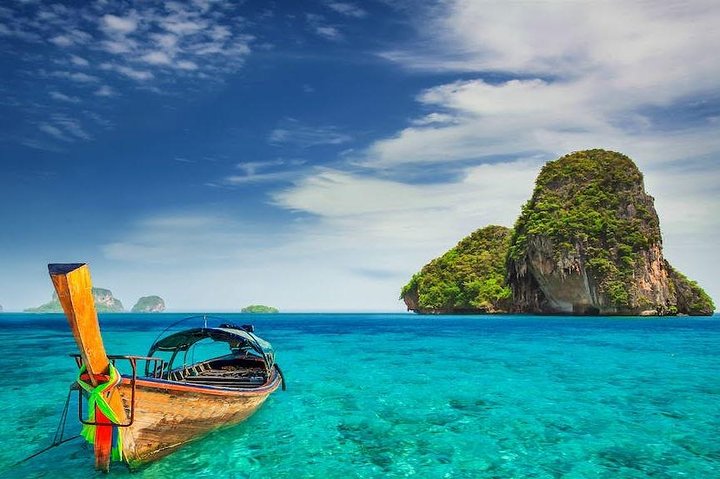 this Chiang Rai day trip and it was a long day but well-organized — the guide handled all the entry tickets, and I did not have to think about transport once.
Who the bus is NOT for: Anyone trying to do Chiang Rai as a day trip. The bus is fine if you are staying overnight in Chiang Rai. For a day trip, the 7-8 hours of bus travel leaves too little time at the sites. Book a tour or a private driver.
Grab and Ride-Hailing in Chiang Mai
Grab works reliably in Chiang Mai. A GrabCar from the airport to the old city costs 150-180 baht. Within the city, most rides are 60-120 baht. Grab is almost always cheaper than a tuk-tuk quote and you do not have to negotiate.
The one exception: during the Sunday Walking Street market (4pm-midnight), roads around the old city are closed to vehicles. Grab drivers cannot enter the old city gates — they will drop you at Tha Phae Gate or Chiang Mai Gate and you will walk from there. Budget an extra 10-15 minutes if you are heading to the market area on a Sunday evening.
Bolt is also available in Chiang Mai and is sometimes 10-20 baht cheaper than Grab. I use both and take whichever has the shorter wait time. At 5-6pm on weekdays, wait times for both can exceed 15 minutes — this is Chiang Mai rush hour, and the roads around the moat get backed up.
Renting a Scooter: The Cheapest Option, With Real Risks
Scooter rental in Chiang Mai costs 200-300 baht per day. Most shops near the old city will rent to you with just a passport deposit — no license check. This is the cheapest way to explore Doi Suthep, the Samoeng Loop, and the countryside around Chiang Mai.
But here is what the rental shops do not tell you: if you do not have an International Driving Permit (IDP) with a motorcycle endorsement, you are driving illegally. Police checkpoints on the road to Doi Suthep and around the old city moat are common — the fine is 500-1,000 baht. Your travel insurance will not cover you if you crash without a valid license. I have seen tourists with road rash and no insurance facing hospital bills of 30,000+ baht at Chiang Mai Ram Hospital.
If you are an experienced rider with an IDP, a scooter opens up Chiang Mai in a way nothing else can. The road to Doi Suthep at sunrise, with the city lights fading below you, is one of the best rides in northern Thailand. The Samoeng Loop — 100km of mountain roads, waterfalls, and strawberry farms — is a full day of riding with almost no traffic. But if you have never ridden a scooter before, Chiang Mai's mountain roads are not the place to learn.
Who scooters are NOT for: First-time riders, anyone without an IDP, and anyone visiting during rainy season (June-October). The roads get slick, visibility drops, and the mountain curves become dangerous. I rode the Samoeng Loop in July and spent two hours in light rain with my visor fogged up — not an experience I would repeat.
What I Wish I'd Known Before My First Chiang Mai Trip
- The songthaew system rewards patience. If you are not in a rush, songthaews are the cheapest and most local way to move around. If you are on a schedule, pay for Grab. The 40 baht you save on a songthaew is not worth missing a tour departure.
- Negotiate tuk-tuk prices before getting in, and halve the first quote. A 60-baht ride should not cost 200. If the driver will not budge, walk away — there is always another one.
- For Doi Inthanon, book a tour or private driver — do not try to do it independently. There is no public transport to the summit. I met a traveler who tried to hitchhike up and spent three hours at the base before giving up.
- Chiang Rai as a day trip works only with a tour or private driver. The bus takes too long and leaves too little time at the sites. I have done it both ways — the bus trip was exhausting and rushed.
- Carry small notes (20, 50, 100 baht) for songthaews. Drivers rarely have change for a 1,000-baht note at 7am. I once held up a songthaew full of commuters while the driver ran into a 7-Eleven to break my 1,000.
- Grab works everywhere in Chiang Mai, but budget extra time on Sunday evenings and weekday rush hours. The old city moat roads back up between 5-6pm.
Chiang Mai transport is affordable, flexible, and mostly straightforward once you understand the options. The songthaew system is unique to northern Thailand and worth experiencing at least once. But when you have a tour to catch or a mountain to climb, spend the extra baht on a Grab or a private driver. The money you save on a 30-baht songthaew evaporates the moment you miss your Doi Inthanon departure.
Explore More
Related guides from Day Trips from Bangkok:
The three Bangkok day tours worth doing are: Ayutthaya (ancient temple city, 90 minutes north by train), Damnoen Saduak floating market (90 minutes southwest, best before 8am), and Kanchanaburi with Erawan Falls (2.5 hours northwest). All three are accessible by organised tour or public transport. If you have one day only: go to Ayutthaya - it is the most historically significant and the train ride is part of the experience. Book the small-group Ayutthaya tour if you want everything handled - or take the 15-baht train if you want the adventure.

How to use this guide
Each section below covers one destination: what it offers, how to get there independently, and which tours are available on Viator. All tour links are affiliate links, we earn a commission if you book, at no extra cost to you. Our recommendations are based on review ratings, itinerary content, and operator track record.
1. Ayutthaya, The Temple City
Ayutthaya was Thailand's capital from 1350 to 1767. What remains is a compact island of temple ruins, the most historically significant UNESCO World Heritage site within easy reach of Bangkok. The iconic image is the row of three chedi at Wat Phra Si Sanphet against a clear sky. The most photographed detail is the Buddha head in the Bodhi tree roots at Wat Mahathat.
What you will see
- Wat Mahathat, Buddha head in tree roots, crumbling prang spires. Entry ฿50. Arrive by 7:30am to beat tour groups.
- Wat Phra Si Sanphet, The classic silhouette: three chedi in a row. Entry ฿50. Dress code enforced.
- Wat Ratchaburana, Climbable prang with 14th-century murals. Entry ฿50. Less crowded early morning.
- Optional: Wat Chaiwatthanaram (sunset Khmer temple, south of the island, ฿50), Wat Phra Yai (reclining Buddha on the far island, ฿20)
Independent or by tour?
The train is the best best for Ayutthaya. Bang Sue Grand Station (MRT Blue Line, chatuchak entrance) has frequent trains to Ayutthaya Railway Station, ฿20–50 second class, 1h30m–2h. Arrive by 8:30am, rent a bicycle at the station (฿40–60/day), and circuit the main temples before the afternoon coach groups. Total independent cost: ฿300–500 per person including transport, entry fees, and lunch.

A tour makes sense if you want a guide explaining the history, or if you want to combine Ayutthaya with a river boat crossing and lunch on the water. The full-day tours from Bangkok include transport, a local guide, and lunch, and get you to the most significant sites without the logistics.

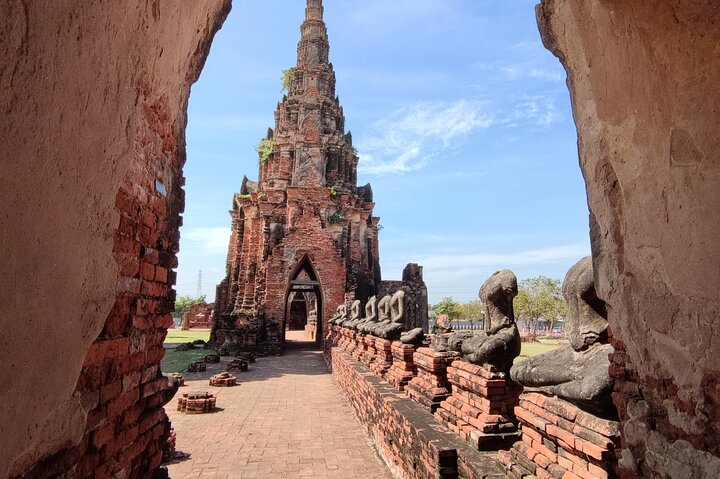
Ayutthaya Historical Park Small-Group Tour
Covers Wat Mahathat, Wat Phra Si Sanphet, and Wat Ratchaburana with a local guide. Transport by air-conditioned minivan, includes lunch. Max 12 people, manageable and not crowded.
Why it made the cut: The 12-person cap on this tour is the sweet spot - big enough to keep costs down, small enough that you're not herding through temple gates.
- ✓ Hotel pick-up
- ✓ Lunch
- ✓ Guide
- ✓ Transport
 View on Viator →

Ayutthaya Temple Tour with River Cruise
Covers the main temples plus a river boat crossing to Wat Phra Yai on the far island. The boat adds a different perspective on the island and breaks up the day. Lunch included.
Why it made the cut: The river boat crossing to Wat Phra Yai saves 40 minutes of road time and gives you temple views from the water - a perspective most group tours miss .
Operator Interviewed · 4.6★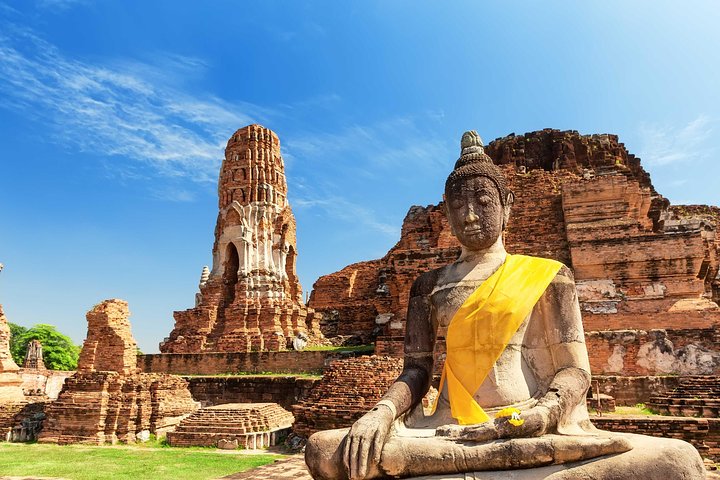 View on Viator →
Personal Story
The 15-Baht Train I'll Never Forget
February 2024. Hualamphong Station at 6:15am. Third-class carriage, wooden seats, windows open. The train crawled through Bangkok's northern suburbs - past houses built up to the tracks, kids waving, monks boarding at suburban stations. Two hours later: Ayutthaya. I was cycling between temples by 8:30am while tour buses were still loading in Bangkok. The train costs 15 baht - about 40 cents. It's not comfortable but it's the most honest way to arrive. You see the route, meet locals, and arrive before the crowds. If you take the train, bring water and a hat. If it's hot season, maybe just book the air-conditioned tour.
2. Damnoen Saduak Floating Market
Damnoen Saduak is the most famous floating market within a day trip of Bangkok, and also the most tourist-heavy. The boats are loaded with tropical fruit, pad thai, coconops, and handmade goods. The canal is busy by 8am, and the atmosphere shifts from working market to tourist attraction after 9am. It is worth going, but timing matters more here than anywhere else in this guide.

What you will see
- The canal, Long-tail boats navigate the narrow waterways. The morning light before 7:30am is photogenic.
- Food vendors, Fresh mango, sticky rice, grilled seafood, coconut pancakes cooked from boat kitchens.
- Maeklong Railway Market, Often combined with Damnoen Saduak. The market sets up on a functioning train track; the train passes through four times daily, vendors pulling their stalls back seconds before it arrives. Surreal and worth the detour.
- The tourist factor, Damnoen Saduak is not a lesser-known. It is commercialised and crowded after 9am. If you want a more authentic market experience, Amphawa (Friday–Sunday evenings) or Tha Kha (Wednesday mornings) are alternatives, but both are smaller and harder to reach independently.
Independent or by tour?
Damnoen Saduak by public transport is doable but requires a minivan from Bangkok's Southern Terminal (Sai Tai Mai) or a taxi. The journey takes 90 minutes to 2 hours depending on traffic. Most visitors opt for a tour that combines Damnoen Saduak with the Maeklong Railway Market, the railway market is walking distance from a pick-up point, so the logistics are simpler with a guide.

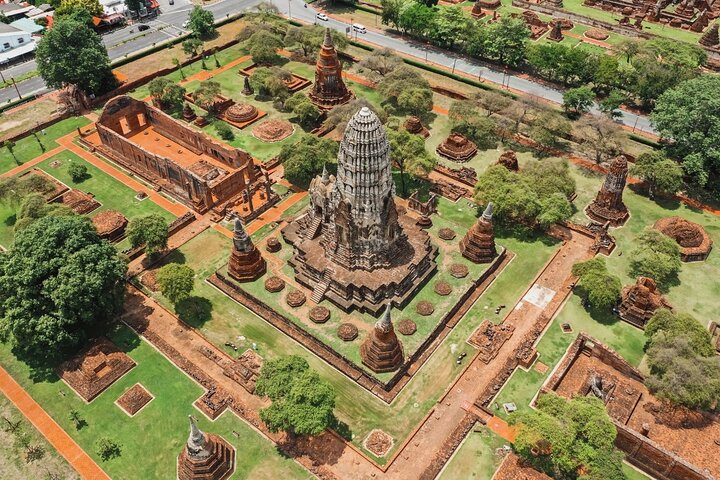
Damnoen Saduak + Maeklong Railway Market
Full morning tour combining the floating market with the Maeklong Railway Market. Hotel pick-up, air-conditioned transport, boat ride through Damnoen Saduak canal included. Arrive early enough to be in the market before the tour groups.
Why it made the cut: The Maeklong train pass is unlike anything else near Bangkok - vendors retract their stalls in under a minute as the locomotive rolls through.
- ✓ Hotel pick-up
- ✓ Transport
- ✓ Guide
 View on Viator →
Personal Story
Damnoen Saduak: The 90-Minute Window
I've done Damnoen Saduak twice. At 7:15am: wooden paddlers delivering produce, morning light hitting the water, maybe 30 tourists spread across the canal. Peaceful. Working. Photogenic. At 10am the same day, same canal: 200+ tourists, motorboats churning brown water, every vendor selling identical elephant-print pants. Same place, same boats, different experience. The difference between a good floating market morning and a bad one is 90 minutes. If your tour picks you up from Bangkok after 7am, you've missed the window. Book the 6am departure. Stand on the platform at Maeklong, not on the tracks - the vendors will shout at you, and they're right.
3. Kanchanaburi and Erawan Falls
Kanchanaburi is best known for two things: the Death Railway (built by POWs during WWII, crossing the River Kwai bridge) and Erawan Falls, a four-tier waterfall inside a national park, 65km north of Kanchanaburi town. Erawan is one of Thailand's most visited national parks and the falls are worth the trip, especially in the rainy season when all seven tiers are flowing.
What you will see
- Erawan Falls, Tier 1 is at the park entrance; each subsequent tier is higher and less crowded. Tier 4 has large natural pools for swimming. Tier 5 and 7 involve some climbing; they may be closed during or after heavy rain. Park entry ฿300 for foreign adults.
- Bridge over the River Kwai, The historic railway bridge, rebuilt after WWII. The Death Railway continues north to Nam Tok station (the final stop, another 30 minutes). The bridge is most atmospheric at sunset.
- Hellfire Pass Memorial, For visitors with interest in WWII history: the site of the most difficult section of the railway construction. Free entry, well-maintained, moving. Often included in historical tours.
Independent or by tour?
Getting to Erawan Falls independently requires train + songthaew logistics (4–5 hours each way by public transport). A tour removes the complexity: door-to-door pickup, arrives at Erawan by mid-morning, returns by early evening. If you want to combine the bridge and the falls in one day, a tour is the practical option, coordinating both by public transport is complex for first-time visitors.

Full day · Bridge + Falls combo
Kanchanaburi Day Tour, Erawan Falls and River Kwai Bridge
Covers both Kanchanaburi highlights in one day: the bridge, the Death Railway short ride, and Erawan Falls. Small group, air-conditioned minivan, includes lunch. Typical schedule: depart Bangkok 7am, return 6–7pm.
Why it made the cut: Erawan Falls' seven turquoise tiers are the most worthwhile natural attraction within day-trip range - this tour handles the 3-hour drive each way so you don't have to.
Personally Reviewed · 4.6★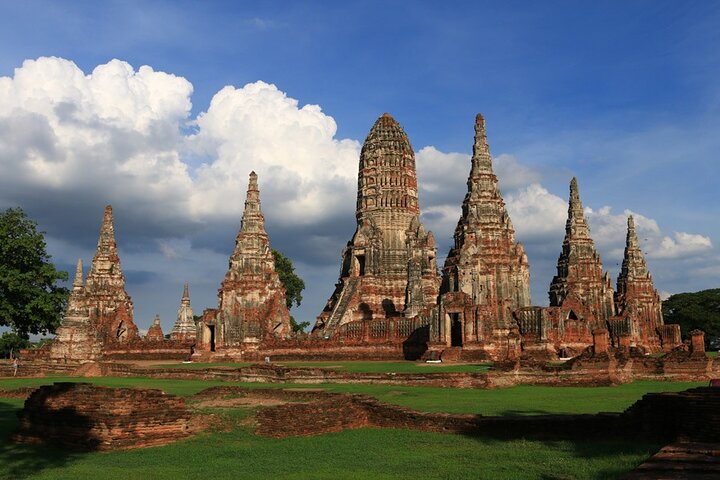 View on Viator →
Personal Story
The Kanchanaburi Cemetery at Dawn
November 2023. I arrived at the Kanchanaburi War Cemetery at 7am, before any tour bus had pulled in. Morning light hit the gravestones at a low angle. The cemetery is immaculately maintained - grass cut to the same height, every headstone aligned. Reading the ages on the stones - 19, 22, 24, 27 - and then seeing 'Known Unto God' on the unidentified graves changes how you experience the Bridge over the River Kwai. Go to the cemetery BEFORE the bridge. The bridge makes more sense when you understand what was lost to build it. An estimated 100,000+ people died constructing the Death Railway. That number matters more standing among the graves than reading about it in a guidebook.
Which day trip should you do?
| Ayutthaya | Damnoen Saduak | Kanchanaburi + Erawan | |
|---|---|---|---|
| Best for | History, temples, UNESCO heritage | Markets, food, photography | Nature, waterfalls, WWII history |
| Time needed | Full day (8am–6pm) | Half day (6:30am–1pm) or full day combined | Full day (7am–7pm) |
| Independent difficulty | Low, train is straightforward | Medium, minivan/logistics complex | High, multiple connections for falls |
| Budget (by tour) | ฿1,800–2,800 | ฿1,200–1,800 | ฿1,800–2,500 |
| Physical demands | Low, cycling flat, temples close together | Low, boat and walking | Medium, hiking to upper tiers of falls |
| Go independently? | Yes, train + bicycle | Tour recommended for logistics | Tour recommended for combination |
Honest take
If you have one day: Ayutthaya. It is the most substantial destination, the train ride is scenic and part of the experience, and the temple ruins are impressive. You will not regret it.
If you have two days: Ayutthaya on day one, and either floating markets (half-day morning trip) or Kanchanaburi on day two. Damnoen Saduak pairs well with Ayutthaya if you want two destinations in one day, many tours offer this combination.
Kanchanaburi and Erawan Falls deserves a full day on its own. Don't rush it, the falls are worth 2–3 hours and the bridge at sunset is a different experience from the daytime temple circuit of Ayutthaya.
External resources
Some links on this page lead to Viator where we earn a commission if you book. This does not affect our editorial content, we recommend tours based on research, not commission rate. Learn more about our approach.
Is a Bangkok Day Trip Right for You?
Book this if...
- You're based in Bangkok for 3+ days and want to see beyond the city
- You want temples, markets, or waterfalls without overnight logistics
- You're a first-time visitor - these three destinations are the proven day-trip circuit
Skip this if...
- You're only in Bangkok for 24–48 hours - the Grand Palace, Wat Pho, and Chinatown need that time
- You dislike early starts - floating markets and temple runs work best before 8am
- You're visiting in September–October - Erawan Falls trails can close in heavy rain
Best time to visit: November–February. Price range: ฿1,200–฿2,800. Nearest alternative: Bangkok's own temples and khlong tours if you're short on time.