Bangkok Day Trips in Rainy Season: What's Still Worth Doing
We earn a commission when you book through our links on Viator (PID P00299531), at no extra cost to you. This is how we keep the site free. Learn more →
Bangkok in Rainy Season: What Changes and What Doesn't
Rainy season in Bangkok runs June through October. The pattern that matters for planning is narrow: afternoon rain most days, with mornings still workable. Morning tours remain a practical option across these months, which is why the departure time printed on your booking carries more weight in June than it does in January.
The Thai Meteorological Department publishes Thailand's monsoon and storm warnings, and that is the page worth opening the night before a booked tour. You are not checking whether it will rain. In these months it rains.
The other half of the decision is what kind of ground your day trip puts you on. A canal market day keeps you in a boat and under the awnings of a working market. A temple day puts you on open ground between ruins with the sky doing whatever it wants. Neither is ruled out by wet season, but they fail differently when the weather turns, and that should shape which one you book first. For broader month-by-month context, our Bangkok seasons guide covers the full year.
The dry season (November to February) is cooler and dry, and the trade is real: peak season means booking ahead and sharing the major sites with a crowd.
Damnoen Saduak Floating Market and Maeklong Railway Market Tour: Two Markets in One Morning
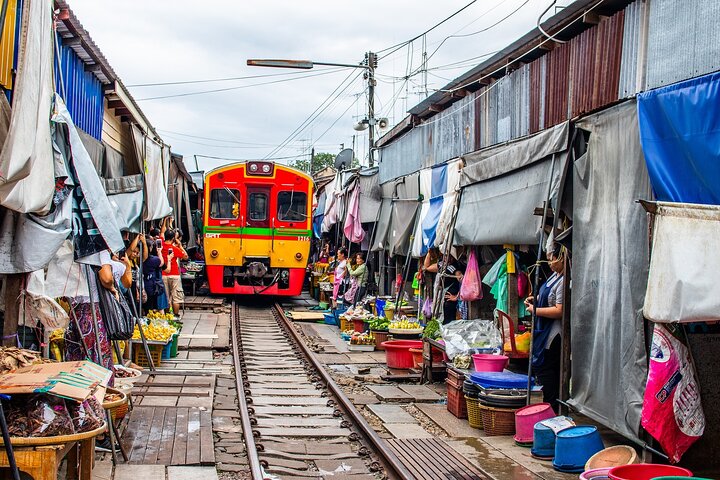
This one pairs Damnoen Saduak Floating Market with Talad Rom Hoop, the market that sits directly on the railway track, where vendors pull back their awnings within seconds as the Bangkok to Maeklong train comes through. The railway market is the stronger half of the pairing. Watching an entire row of stalls fold itself flat and reopen behind a passing train is the kind of thing that holds up in any weather, because it is happening under cover and it is happening regardless of you.
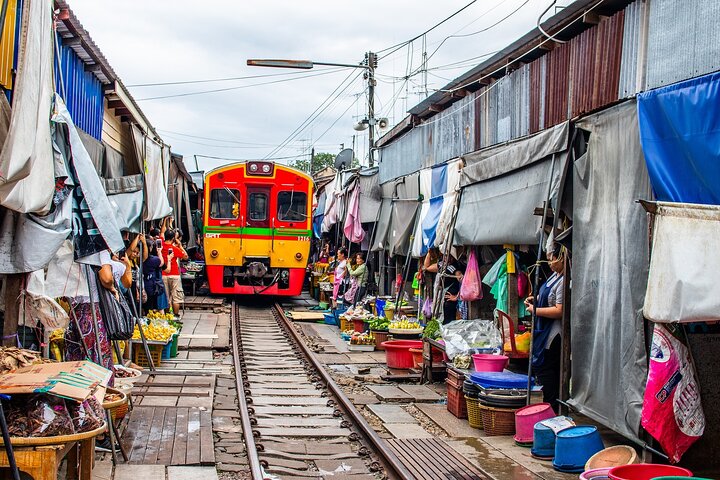
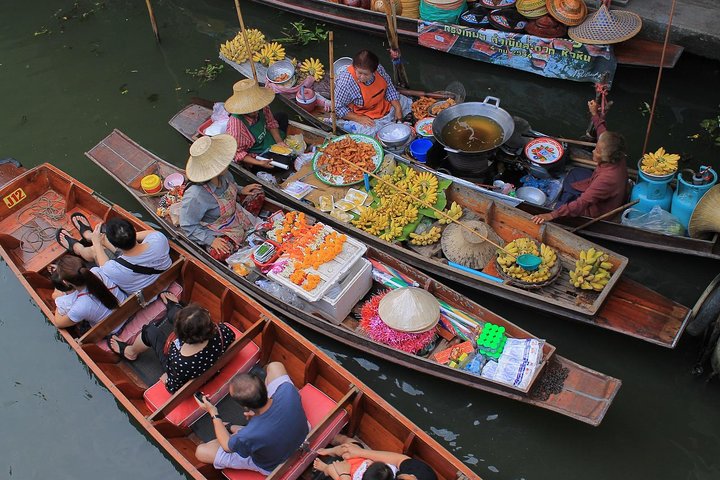
Damnoen Saduak deserves a straight description: it has evolved into a tourist attraction. The boats are tourist boats and the vendors are working tourists. That does not make it worthless, and the canal traffic itself is unlike anything you will see elsewhere, but book it knowing what it is. This tour suits travellers who want both markets and accept Damnoen Saduak on those terms.
Damnoen Saduak Floating Market and Maeklong Railway Market Tour
From $33 · Price checked: Jul 2026
Best for: Travelers who want both markets and accept that Damnoen Saduak has evolved into a tourist attraction.
Not for: Travelers looking for a market that has stayed outside the tourist circuit.
A visit to Damnoen Saduak Floating Market followed by Talad Rom Hoop, the market sitting on the railway track where vendors pull back their awnings within seconds as the Bangkok to Maeklong train passes.
Check availabilityExternal booking on Viator · pricing and cancellations handled by Viator
What Still Works on a Wet-Season Day Trip
Market itineraries hold up better than open-air sightseeing in June through October, because commerce does not stop for rain and the interesting part happens under awnings and on water. The workable formula is the same one every month: get out of Bangkok early, do the outdoor portion before lunch, and treat the afternoon as the flexible part of the day.
That is why the departure time is the single specification worth comparing between two otherwise similar market tours. An itinerary that reaches the canals early is buying you the dry part of the day. One that leaves mid-morning is spending it. Our floating markets overview sets out how the individual markets differ, and the wider Bangkok day tours page covers what else runs from the city.
The second thing to weigh is how much of the day you want committed. A half-day format gets you back to Bangkok with the afternoon free, which in wet season is a feature rather than a compromise, since you can put the indoor half of your sightseeing into the hours the rain is likely to land.
Choose a full-day itinerary instead if your group would rather have one guided day than two half-planned ones, or if the shorter format leaves you with an afternoon you have no plan for.
Half-Day Floating Market and Railway Market Tour from Bangkok: The Local-Train Version
The difference here is the approach. This half-day trip reaches the Maeklong Railway Market by local train, then continues to Damnoen Saduak Floating Market.
If you take the operator's advice on departure time, you get thinner crowds and a longer window before the afternoon weather arrives. If you book it and then negotiate yourself down to a later start, you have paid for a tour and removed the reason it works.
Half-Day Floating Market and Railway Market Tour from Bangkok
From $25.97 · Price checked: Jul 2026
Best for: Travelers who want to reach the railway market by local train and can take an early departure.
Not for: Travelers who cannot take an early departure or want to avoid an early-morning start.
A half day trip reaching the Maeklong Railway Market by local train, then continuing to Damnoen Saduak Floating Market. The operator suggests the 6.00 am or 6.30 am departures for fewer tourists and more time at both markets.
Check availabilityExternal booking on Viator · pricing and cancellations handled by Viator
What Rainy Season Does to an Ayutthaya Day
Ayutthaya is the day trip most affected by the calendar, and not only by rain. March to May is the hottest period, with early morning visits the practical answer to the heat. June through October trades that heat for afternoon rain most days, which is a different problem and, for a lot of travellers walking between temple ruins, a more manageable one.
The historical park is open ground. You walk between sites, and there is no version of that where a downpour is convenient. What wet season gives you in exchange is temperature and light that are easier on a full day outdoors than late April. The Tourism Authority of Thailand's destination pages are the official reference for the province itself, and the main Tourism Authority of Thailand site carries current travel advisories worth reading before you lock in dates.
Rainy season is a poor fit for travellers who cannot adapt an itinerary mid-day. If a shower means the day is written off rather than reordered, the dry season is the honest recommendation and you should plan around the crowds instead.
UNESCO's Ayutthaya Historical Park Full-Day Tour from Bangkok
A small-group day trip covering Wat Mahathat, Wat Chaiwatthanaram, Wat Yai Chai Mongkol and Bang Pa-In Royal Palace, with commentary on Thai Buddhism at the temples. Bang Pa-In is the reason to look at this one over a ruins-only itinerary. It is a different register from the temple sites and it breaks up a day that can otherwise blur into a sequence of brick.
Two-way transfers run from Bangkok hotels in selected areas or from National Stadium Station, and the word "selected" is doing real work there. Confirm your hotel is on the pickup list before booking, because the station meeting point is the fallback and you want to know that in advance rather than at dawn. More detail sits on our Ayutthaya day trip page.
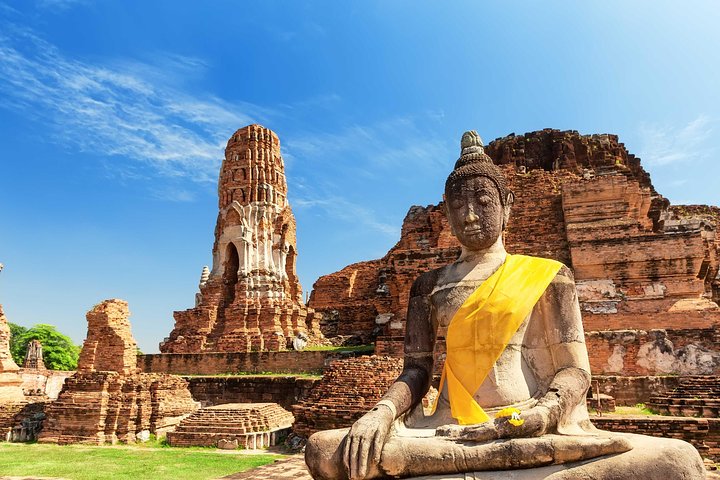
UNESCO's Ayutthaya Historical Park: Full-Day Tour from Bangkok
From $30 · Price checked: Jul 2026
Best for: Travelers who want Bang Pa-In Royal Palace included alongside Ayutthaya's temple ruins.
Not for: Travelers who want the historical park only, without a palace stop.
A small group day trip to Ayutthaya covering Wat Mahathat, Wat Chaiwatthanaram, Wat Yai Chai Mongkol, and Bang Pa-In Royal Palace, with commentary on Thai Buddhism at the temples. Two-way transfers run from Bangkok hotels in selected areas or from National Stadium Station.
Check availabilityExternal booking on Viator · pricing and cancellations handled by Viator
Niran Chantra's Insider Tips for Getting It Right
On timing, resist the instinct to treat an early start as something to optimise away. Every advantage a market tour has in these months comes from being finished with the outdoor portion before the weather arrives. On forecasts, a long-range wet-season outlook for Thailand tells you almost nothing useful, since the answer is rain. A same-week check against the Thai Meteorological Department's warnings tells you whether something larger is moving through.
On pickup, read the transfer conditions properly. Hotel collection in selected areas is not the same as hotel collection, and a meeting point at National Stadium Station is easy to reach once you know that is the plan. Pack for being wet and comfortable about it rather than for staying dry, because on a boat in a canal market, dry is not on the menu in September.
None of this helps a traveller with a single fixed day in Bangkok and one shot at a day trip. If that is your situation, book the market tour with the earliest departure and accept the narrower experience, because the flexibility these tips depend on is exactly what you do not have.
What to Check Before Booking
What the listing says decides how a rainy-season booking behaves, and all of it is visible before you pay.
The cancellation terms deserve a slow read. They are set by the operator, not by us, and rain in a season defined by rain is not the same thing as a cancellation event.
Booking lead time works differently across the year. The dry season from November to February is the peak stretch, when booking ahead is the difference between the tour you wanted and whatever is left. June through October gives you more room, though the early-departure slots on the popular market itineraries are the ones that go first, so treat those as the exception.
One last check: match the tour to the traveller, not to the month. Rainy season does not rescue a tour you were lukewarm about, and it does not ruin one you had a clear reason to book.
Explore More
Related comparisons and guides:
Frequently Asked Questions
Is rainy season a bad time for Bangkok day trips?
No, but it narrows your options in the afternoon.
Floating markets or Ayutthaya in the wet months?
The market tours are the safer wet-season booking because the interesting part happens on water and under awnings, while Ayutthaya's temple sites leave you on open ground. If you only have room for one day trip between June and October, take the markets.
Why do operators recommend such early departures?
Two reasons stack in your favour. Fewer tourists are at the markets early, and you finish the outdoor portion before the afternoon weather arrives, so a departure time you would otherwise negotiate down is the thing protecting the day.
Will my tour be cancelled if it rains?
Weather and cancellation terms are set by the individual operator and appear on the listing you book, so read them before paying, not after. In a season defined by daily rain, a shower and a cancellation event are not the same thing.
Do I need to book Bangkok day trips ahead in June through October?
You have more room than in the November to February peak, when booking ahead and crowds at major sites are the norm. The exception is the earliest departure slots on the market tours, which fill regardless of season.
Where should I check official weather and destination information?
The Thai Meteorological Department covers monsoon and storm warnings, and the Tourism Authority of Thailand publishes destination pages and current travel advisories. Both are free, official, and more useful the closer you check them to your travel date.
Written from Bangkok, Thailand.

Niran Chantra
Bangkok local · 300+ day trips across Thailand