Bangkok Floating Market Day Trips: Which Damnoen Saduak Format Should You Book?
We earn a commission when you book through our links on Viator (PID P00299531), at no extra cost to you. This is how we keep the site free. Learn more →
Three Damnoen Saduak day trips from Bangkok are featured on this page, and they differ less in what they put in front of you than in when they get you there and how much of your day they consume. That is the decision worth spending five minutes on. According to the Tourism Authority of Thailand, Damnoen Saduak floating market is about 100km southwest of Bangkok (1.5 hour drive), so every version of this trip begins with an early pickup and a run down the highway.
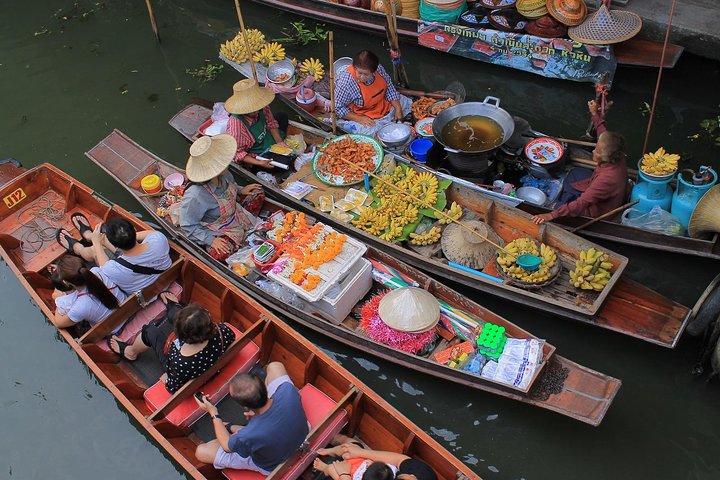
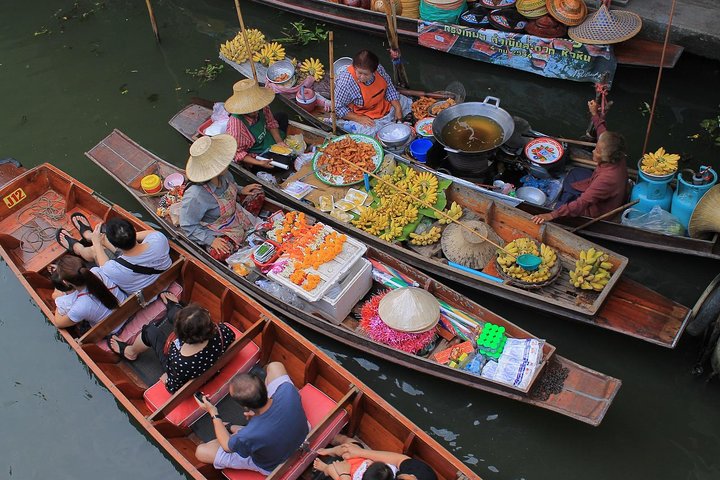
What waits at the other end is a canal system jammed with wooden boats, paddlers working through narrow channels, and a density of trade on the water you will not see from a footpath. What does not wait for you is a market where Thai families shop. According to the Tourism Authority of Thailand, Damnoen Saduak vendors now mainly sell tourist souvenirs rather than fresh produce. Book with that understood and the morning holds up. Book expecting a working produce market and you will spend the boat ride feeling cheated.
How the Three Damnoen Saduak Formats Differ
The three trips split along two lines: how early they leave Bangkok, and how they handle Maeklong Railway Market. Departure time controls your crowd exposure at the canal. The Maeklong handling controls whether you arrive at that market as a passenger on the train or stand beside the track watching the stalls fold themselves out of its way.
According to the Tourism Authority of Thailand, Damnoen Saduak is busiest 8-10am when tour buses arrive from Bangkok. Anything that puts you on the water before the coaches unload gives you paddlers and vendors working at their own pace. Anything that lands mid-window gives you a queue of boats nose to tail.
Half-Day Floating Market and Railway Market Tour from Bangkok
This half-day trip reaches Maeklong Railway Market by local train, then continues to Damnoen Saduak Floating Market. The train approach is the reason to pick it. You arrive the way commuters on that line arrive, which reframes the railway market as a piece of functioning infrastructure instead of a photo stop. The operator points travellers toward its earliest departure slots for thinner crowds and more time at both markets, and that advice lines up exactly with the busy window above.
Skip this format if a pre-dawn hotel lobby call is going to wreck the rest of your day in Bangkok. It compresses two markets into half a day, which is efficient and also unforgiving of anyone who needs a slow start. Our wider floating markets overview covers the alternatives for late risers.
Half-Day Floating Market and Railway Market Tour from Bangkok
From $25.97 · Price checked: Jul 2026
Best for: Travelers who want to reach the railway market by local train and can take an early departure.
Not for: Travelers who cannot take an early departure or want to avoid an early-morning start.
A half day trip reaching the Maeklong Railway Market by local train, then continuing to Damnoen Saduak Floating Market. The operator suggests the 6.00 am or 6.30 am departures for fewer tourists and more time at both markets.
Check availabilityExternal booking on Viator · pricing and cancellations handled by Viator
The Value Pick for Bangkok Damnoen Saduak Day Trips
If you want both headline sights with the least fuss, the straightforward two-market coach trip does the job. It covers Damnoen Saduak and then Talad Rom Hoop, the market built directly on the railway track, and it does not dress the floating market up as something it stopped being years ago.
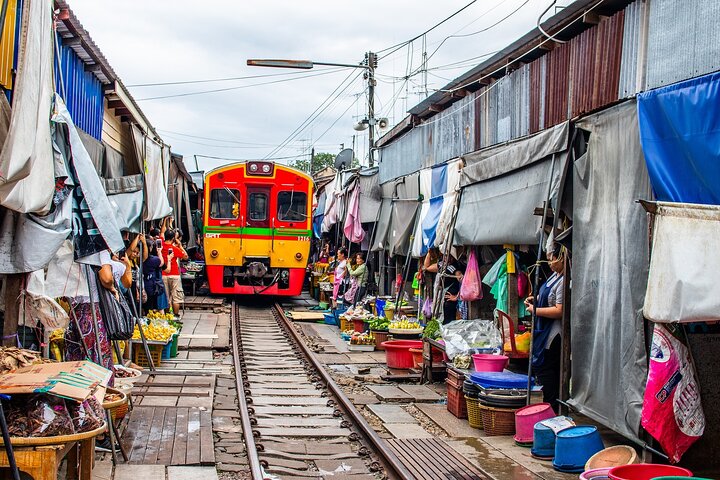
Talad Rom Hoop is the segment that earns its place. Vendors pull their awnings back within seconds as the Bangkok to Maeklong train comes through, then push everything out again once the last carriage clears. Our Maeklong Railway Market guide goes deeper on the trackside logistics.
Damnoen Saduak Floating Market and Maeklong Railway Market Tour
The listing is honest about who it suits: travellers who want both markets and accept that Damnoen Saduak has evolved into a tourist attraction. I rate that framing. A trip that promises a hidden local canal would be selling you something the canal cannot deliver, and this one does not try.
Book the full-day format instead when you want unhurried time on the water, because the two-market structure keeps things moving. Anyone deciding between this and a wider market circuit should read our markets comparison before committing.
Damnoen Saduak Floating Market and Maeklong Railway Market Tour
From $33 · Price checked: Jul 2026
Best for: Travelers who want both markets and accept that Damnoen Saduak has evolved into a tourist attraction.
Not for: Travelers looking for a market that has stayed outside the tourist circuit.
A visit to Damnoen Saduak Floating Market followed by Talad Rom Hoop, the market sitting on the railway track where vendors pull back their awnings within seconds as the Bangkok to Maeklong train passes.
Check availabilityExternal booking on Viator · pricing and cancellations handled by Viator
Worth the Splurge: Day Trip to Bangkok Floating Market & Maeklong Railway
The full-day version buys you two things the shorter trips cannot: unstructured time at the canal, and a meeting point you can walk to. For travellers staying in the Siam and Ratchaprasong area, that alone settles the argument.
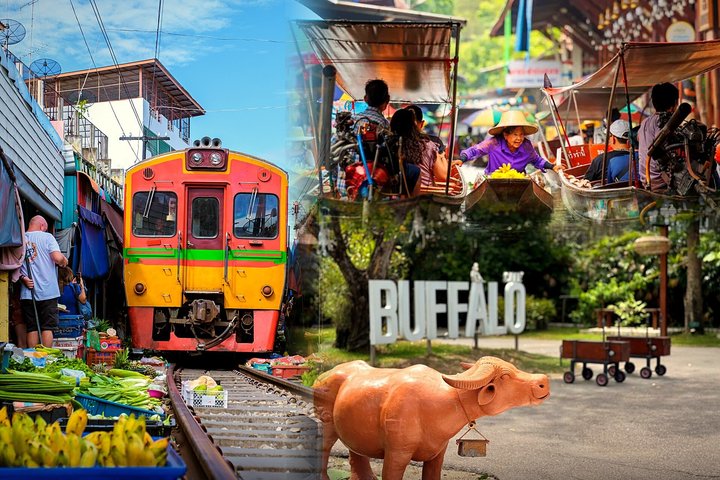
On the canal you get a long-tail boat ride plus the option to explore on foot or rent a rowboat. The rowboat option matters more than it sounds. A long-tail moves you through the market at the driver's pace; a rowboat, or the walkways beside the water, lets you stop where the interesting trade is happening and skip the stretches that are pure souvenir wall. There is also a break at the Buffalo Cafe built into the day, and the trip continues to Maeklong Railway Market to see the train pass through the stalls before returning to Central World.
Day Trip to Bangkok Floating Market & Maeklong Railway
This is the format for people who would rather use a landmark meeting point than coordinate a hotel collection, and for anyone who resents being marched between stops. Choose one of the shorter formats if a full day outside the city would swallow the only afternoon you have for the Grand Palace or Chatuchak. A slow day southwest is a good day, but it is still a whole day. Our Bangkok floating market tour hub and the Damnoen Saduak tour page list what else fits alongside it.
Day Trip to Bangkok Floating Market & Maeklong Railway
From $26.68 · Price checked: Aug 2026
Best for: Travelers happy to meet at Central World rather than arrange transport of their own.
Not for: Travelers who expect food and drinks to be covered, since the cafe stop is at your own expense.
A full day from Bangkok starting at Central World, with a long-tail boat ride at Damnoen Saduak Floating Market, the option to explore on foot or rent a rowboat, and a break at the Buffalo Cafe. The day continues to the Maeklong Railway Market to see the train pass through the stalls before returning to Central World.
Check availabilityExternal booking on Viator · pricing and cancellations handled by Viator
What to Check Before Booking
Everything worth checking is visible before you pay, and none of it can be fixed on the day.
Start with the departure. The Tourism Authority of Thailand's busy window is the benchmark, and a listing offering several start times is asking you to make a decision, not offering a formality. Pick the earliest one your body will tolerate.
On money: credit cards are accepted for online bookings but cash is preferred at local markets. Change baht in Bangkok before you leave, because a canal vendor mid-transaction is not the moment to discover your card is the only thing you brought. Weather is worth a look too, since the boat sections are open to the sky. The Thai Meteorological Department publishes the national forecast in English, and checking it the night before costs nothing.
None of this fixes the underlying trade-off. If what you want is a market where Thai families buy dinner, Damnoen Saduak is the wrong stop and no format on this page changes that. Go for the boats, the paddlers, and the sheer volume of commerce crammed into a narrow canal. That part is real, and it is why the place still draws people at dawn.
Explore More
Related comparisons and guides:
Frequently Asked Questions
How early should my tour leave Bangkok?
As early as the operator offers.
Is Damnoen Saduak a tourist trap?
It is a tourist attraction, and the listings on this page say so plainly. The boats, the paddlers, and the canal traffic are still worth the drive; the shopping is aimed squarely at visitors, so treat souvenir stalls as scenery instead of a reason to bring an empty bag.
Which trip suits someone who doesn't want to arrange transport?
The full-day trip starts and ends at Central World, so you walk to a landmark instead of negotiating a pickup. That suits travellers staying centrally and anyone whose hotel sits outside standard collection zones.
Will I see the train come through Maeklong on every tour?
Two of the three trips here are built around the train passing through the stalls, while the half-day option puts you on the local train into Maeklong instead. Read the itinerary on the card if watching the awnings retract is the part you care about.
Is the half-day version enough?
It covers both markets and gets you back to Bangkok with your afternoon intact, which is the trade it is making. You give up the rowboat time and the unhurried canal wandering that the full-day format builds in.
Written from Bangkok, Thailand.

Niran Chantra
Bangkok local · 300+ day trips across Thailand